Rohan Paul (@rohanpaul_ai)
2024-11-16 | ❤️ 859 | 🔁 163
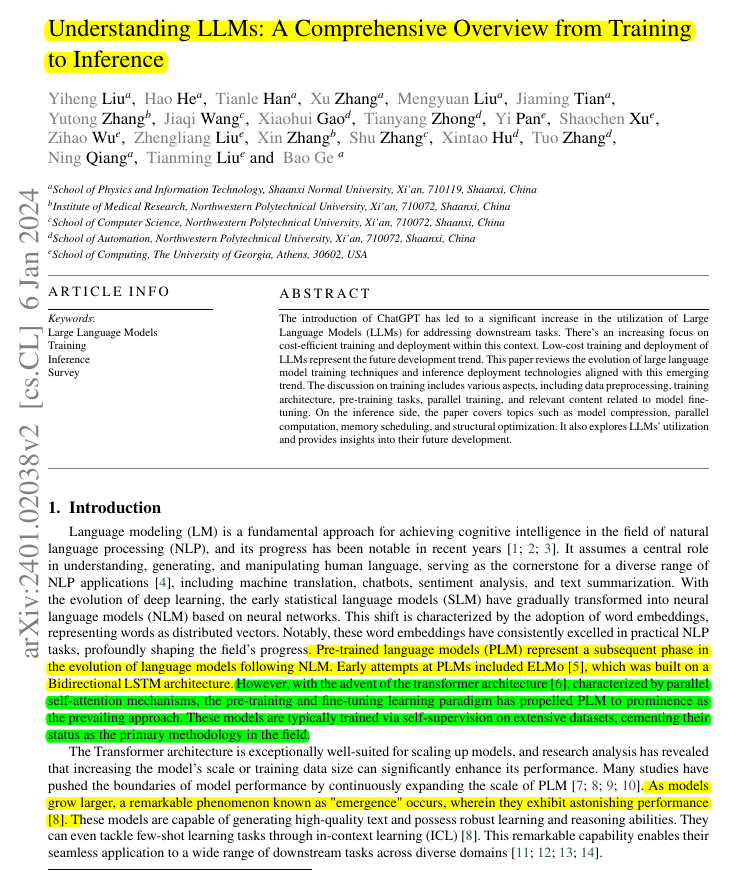
Great read - “Understanding LLMs: A Comprehensive Overview from Training to Inference”
The journey from self-attention mechanism to the final LLMs.
This paper reviews the evolution of large language model training techniques and inference deployment technologies.
→ The evolution of LLMs and current training paradigm
Training approaches have evolved from supervised learning to pre-training and fine-tuning, now focusing on cost-efficient deployment. Current focus is on achieving high performance through minimal computational resources.
→ Core architectural components enabling LLMs’ success
The Transformer architecture with its self-attention mechanism forms the backbone. Key elements include encoder-decoder or decoder-only designs, enabling parallel processing and handling long-range dependencies.
→ Key challenges in training and deployment
Main challenges include massive computational requirements, extensive data preparation needs, and hardware limitations. Solutions involve parallel training strategies and memory optimization techniques.
→ The role of data and preprocessing in LLM development
High-quality data curation and preprocessing are crucial. Steps include filtering low-quality content, deduplication, privacy protection, and bias mitigation.
🔍 Critical Analysis & Key Points:
→ Data preparation strategies drive model quality
Processing raw data through sophisticated filtering, deduplication and cleaning pipelines directly impacts model performance.
→ Parallel training techniques enable massive scale
Using data parallelism, model parallelism and pipeline parallelism allows training billion-parameter models efficiently.
→ Memory optimization is crucial for inference
Techniques like quantization, pruning and knowledge distillation help deploy large models with limited resources.
미디어